
Andrew Ng sits on Amazon's board. Amazon does not list AI as a board skill. Neither does almost anyone else.
AI is in every earnings call, every offsite, every other post in the feed of any senior executive. So I checked where it actually counts: the proxy. The skills matrix boards publish, and the voting policies the big investors grade them on.
The boards first
Of the fifteen largest US companies, exactly one names AI as a board skill. The rest bury it inside "technology," or skip it altogether.
The counterintuitive finding is that the boards with the most AI talent hide it best. Amazon has Andrew Ng, one of the founding figures in modern AI. Walmart has OpenAI's CFO. Microsoft has Reid Hoffman, an original OpenAI board member and one of Silicon Valley's most visible AI investors. None of the three lists AI as a named board competency.
Now the investors
I read every 2026 proxy voting policy from the five largest US equity stewards: Vanguard, BlackRock (which publishes two policies, its US Investment Stewardship policy and its global Active Stewardship policy), Northern Trust, and CalPERS. Every one of them demands that a board's skills match the company's material risks. Only one of them even says the word "AI."
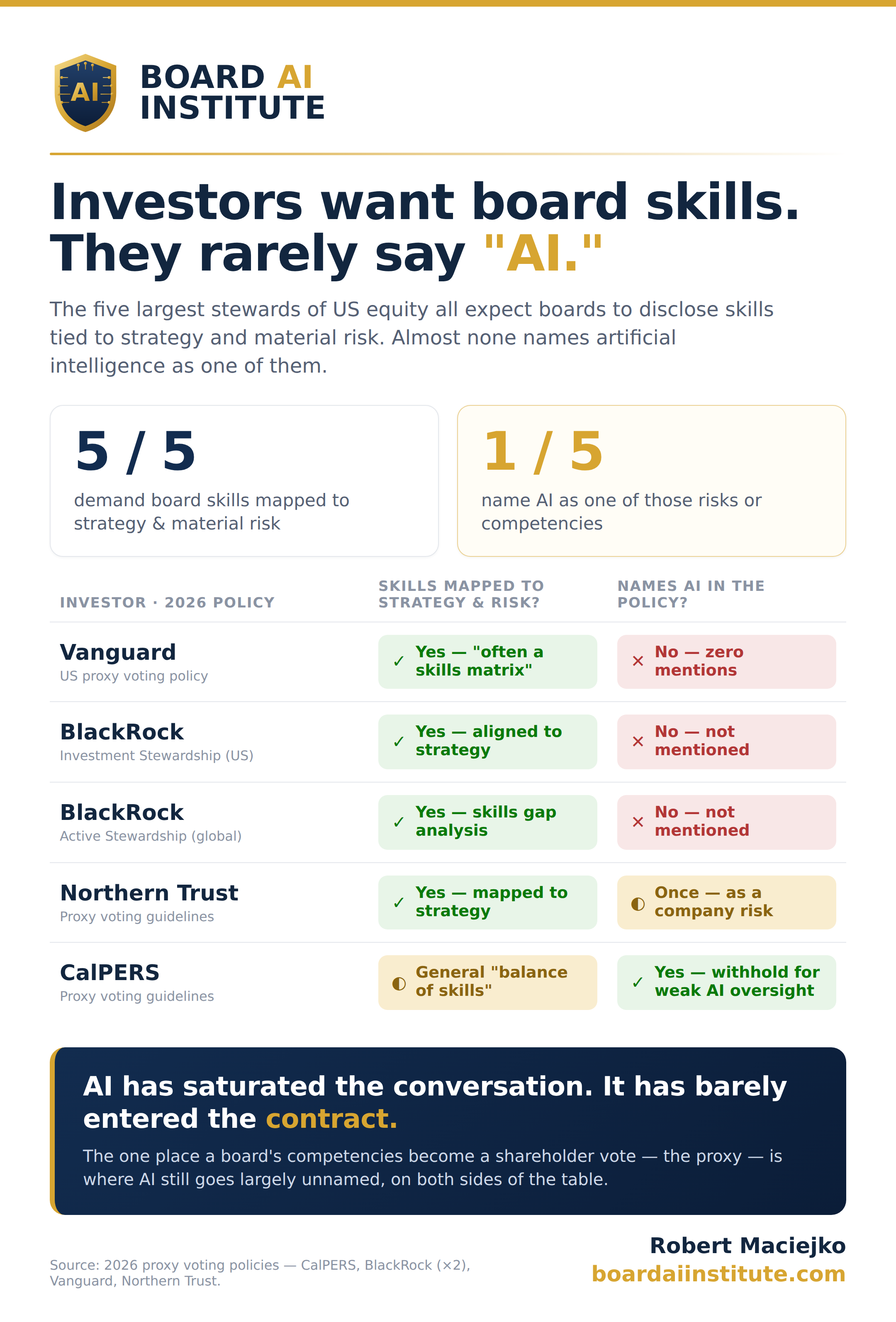
Vanguard talks about a "skills matrix." BlackRock's US and global policies both call for skills aligned to strategy and a skills gap analysis. Northern Trust maps skills to strategy. CalPERS asks for a general "balance of skills." AI shows up in exactly one policy, Northern Trust's, and only as an illustrative company risk. CalPERS is the one that will actually withhold a vote for weak AI oversight.
These are not small voices. BlackRock and Vanguard alone manage roughly $25 trillion between them and are the biggest shareholder in most of the S&P 500. If they are not naming AI in the policy, the policy is not naming AI.
The one place a board's competencies become a shareholder vote
The proxy. That is the one place where a board's competencies become a shareholder vote. And it is where AI still goes largely unnamed, on both sides of the table.
That will not hold. CalPERS just started withholding votes over weak AI oversight. CalPERS moves first. The rest follow. Vanguard, BlackRock, and State Street have historically re-aligned their policies within a proxy season or two of CalPERS' early positions on other topics. Nothing about AI suggests they will move more slowly this time.
What this means for your board
If your company's skills matrix still folds AI into a vague "technology" line, three things are true. Investors reading the proxy cannot see whether you have the competency to oversee AI. Directors reading the matrix cannot tell whether the board itself has a gap. And when the CalPERS position propagates through the other four stewards, you will be exposed at the same moment your competitors are already renaming the line.
The fix is small and precise. Rename the line. Move AI out of "technology" and into its own row. Map the row to specific directors, the way you already map cybersecurity, finance, and industry expertise. Say, in plain language, which directors bring the skill, and how the board plans to close any gap. Do it now, ahead of the 2027 proxy cycle, not after.
The question every director should walk away with: what is your board actually calling it?
This article is part of the Board AI Governance guide, which sets out the STAR framework, the two failure modes, and the operating model that make a named AI competency reviewable quarter to quarter.