Board AI GovernancePower Steering, Not a Brake

AI is changing who wins in every industry, and the board is where that question has to land. Board AI Institute helps boards see what AI means for their company’s competitive position, then oversee the response so management can move fast and stay in control.

Every engagement is confidential. Clients are never named.

  • #2 on SSRN Board AI governance paper
  • Featured Columbia Law and Egon Zehnder
  • Keynote Institute of Directors Global
  • 3,000+ INSEAD AI community

An executive advisory practice founded by Robert Maciejko. Co-author of the #2 most-downloaded board AI governance paper on SSRN.

Active across financial services, healthcare, technology, energy, consumer, and private equity.

The flagship board session

What AI Means for Your Company, and How the Board Steers It

A half-day working session built around your company. We look at how AI is changing your customers, channels and competitors, show directors the tools live, and agree how the board oversees AI.

Who it is for

Chairs and full boards that want AI treated as a competitive question in the boardroom, not a readiness exercise. Governance and risk committees too.

The session in three parts

  • Outside-in. How customers, channels and competitors in your industry use AI, and what the most advanced companies do differently.
  • A live demonstration. How a director can use AI to prepare for a board discussion, using public information only.
  • Oversight with STAR. Where oversight sits across the board and its committees, and the questions directors ask management.
Request this session Scoped with the Chair.
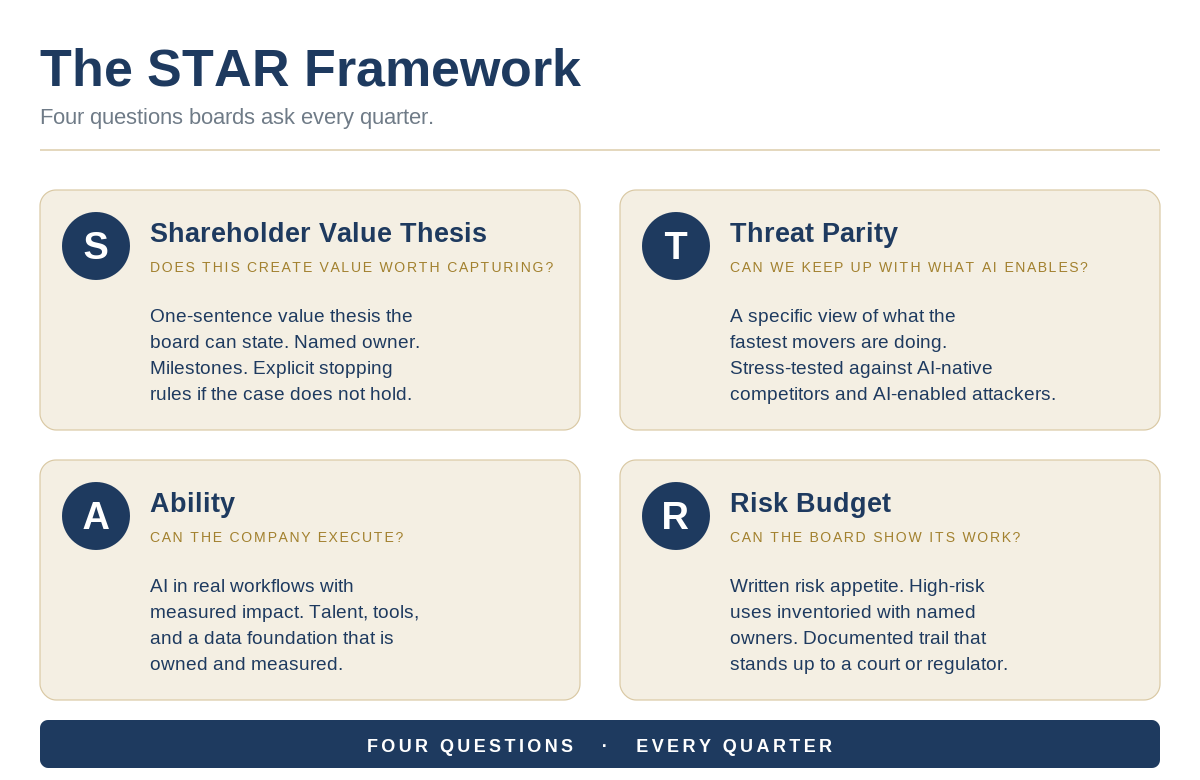
The STAR Framework. Four questions boards ask every quarter. S: Shareholder Value Thesis. T: Threat Parity. A: Ability. R: Risk Budget.

The STAR framework: Shareholder Value Thesis, Threat Parity, Ability, Risk Budget. The operating discipline behind every Power Steering session.

The work behind the practice

#2 on SSRN

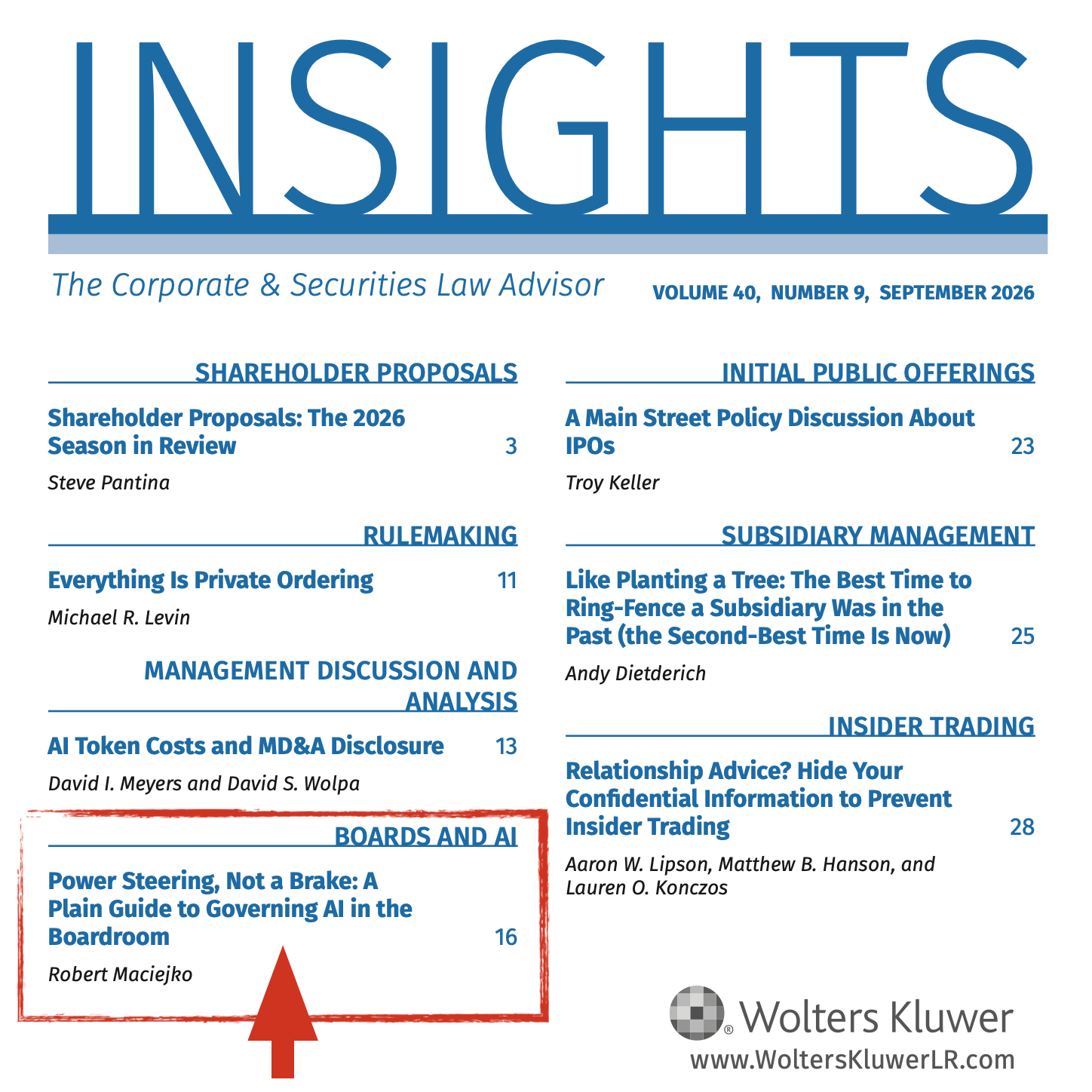
Power Steering, Not a Brake. Co-authored with IESE Business School and Egon Zehnder. The #2 most-downloaded board AI governance paper on SSRN.

Read on SSRN →

SSRN paper · June 2026

The 48-Hour Board: How AI Makes Episodic Governance Obsolete and the Engaged Board Possible. The operating model that comes after STAR. Why six to eight meetings a year breaks under AI compounding, and why the engaged board, long an aspiration, is finally executable.

SSRN paper · August 2026

The Augmented Board: AI, Caremark, and the End of Episodic Oversight. The move from vibe governance to a board that can prove it governed. Delaware Caremark oversight, the Disclosure Mirror, and directors who use AI to stay thickly informed while keeping their own judgment.

On the stage

Keynote at the Institute of Directors Global on corporate governance and ethics in the age of AI.

Panel · INSEAD AI Forum Americas · San Francisco

Three sitting directors on governing AI without slowing the company down.

With Kerry Whorton Cooper, Chair of PG&E and Mozilla; Alison Davis, director of Pagaya, Kraken and Bitwise; and Chitra Nayak, director of Infosys. Moderated by Robert Maciejko, September 2026.

See the panel and the speakers →

How it works

Designed with the Chair. Built around your company.

Preparation

  • Designed with the Chair and the corporate secretary.
  • Short conversations with the CEO and senior management.
  • Management checks the facts on the company slides.
  • An optional pre-read for directors.
  • Short opening and closing words for the Chair.

What the board leaves with

  • A draft of where AI oversight sits across the board and its committees.
  • A draft directors’ AI policy.
  • A short list of questions for management.
  • A one-page quarterly AI report format for management, and a possible twelve-month path.

For the corporate secretary

A draft directors’ AI policy to adapt, a clear view on AI note-takers and board records, and a suggested split of AI oversight between the full board and each committee, ready to write into the governance documents.

What the corporate secretary gets →

The risk runs both ways: too slow, and too fast

Most boards have the policy, the committee, the quarterly slide. Often the harder question, whether any of it changes a decision, has not been asked.

Two failure modes show up again and again, often in the same company. The board that falls behind, approves without scrutiny, and lets AI-native competitors take the upside. And the board that overcorrects, pushes deployment before the controls and data are ready, and draws the scrutiny and shadow AI that follow.

The polite term is a governance gap. The honest one is flying blind. Boards are the last line of defense, and in the US there is no regulation coming to do the job for them.

Session feedback

“Fantastic. Great content and discussions.”

Board Member

“Thank you for the concrete examples, Robert.”

Global Head, Major Business Line

“Excellent presentation. Thank you for the resources too.”

Ex-COO

“So valuable and you are a great presenter.”

Americas Lead

“Bloody brilliant.”

Ex-CEO
Robert Maciejko portrait

Founder, Board AI Institute

Robert Maciejko

Robert has led, built, and chaired for 25 years. He built two businesses from zero to market leadership with the P&L in his hands, and has held board and chair roles.

He created the STAR framework and co-authored Power Steering, Not a Brake, the #2 most-downloaded board AI governance paper on SSRN. He co-founded the INSEAD AI community of 3,000+ senior executives. INSEAD MBA, Princeton BSE, NACD Certified Director.

Read the full bio →

How is your board approaching AI?

Every engagement is confidential. Clients are never named.